



In this competitive academic climate, students are happy to find out “smarter” ways to study that save them time, improve memory retention, and reduce the stress of studying in anticipation of an exam. One effective and powerful yet commonly overlooked study strategy is mind mapping. Mind mapping is a visual learning strategy that helps to organize your thinking, so that you can simplify and condense a lot of information into meaningful and connected ideas.
Mind mapping can help you study better, stay focused, and recall the information you need when it counts!
What Is Mind Mapping?
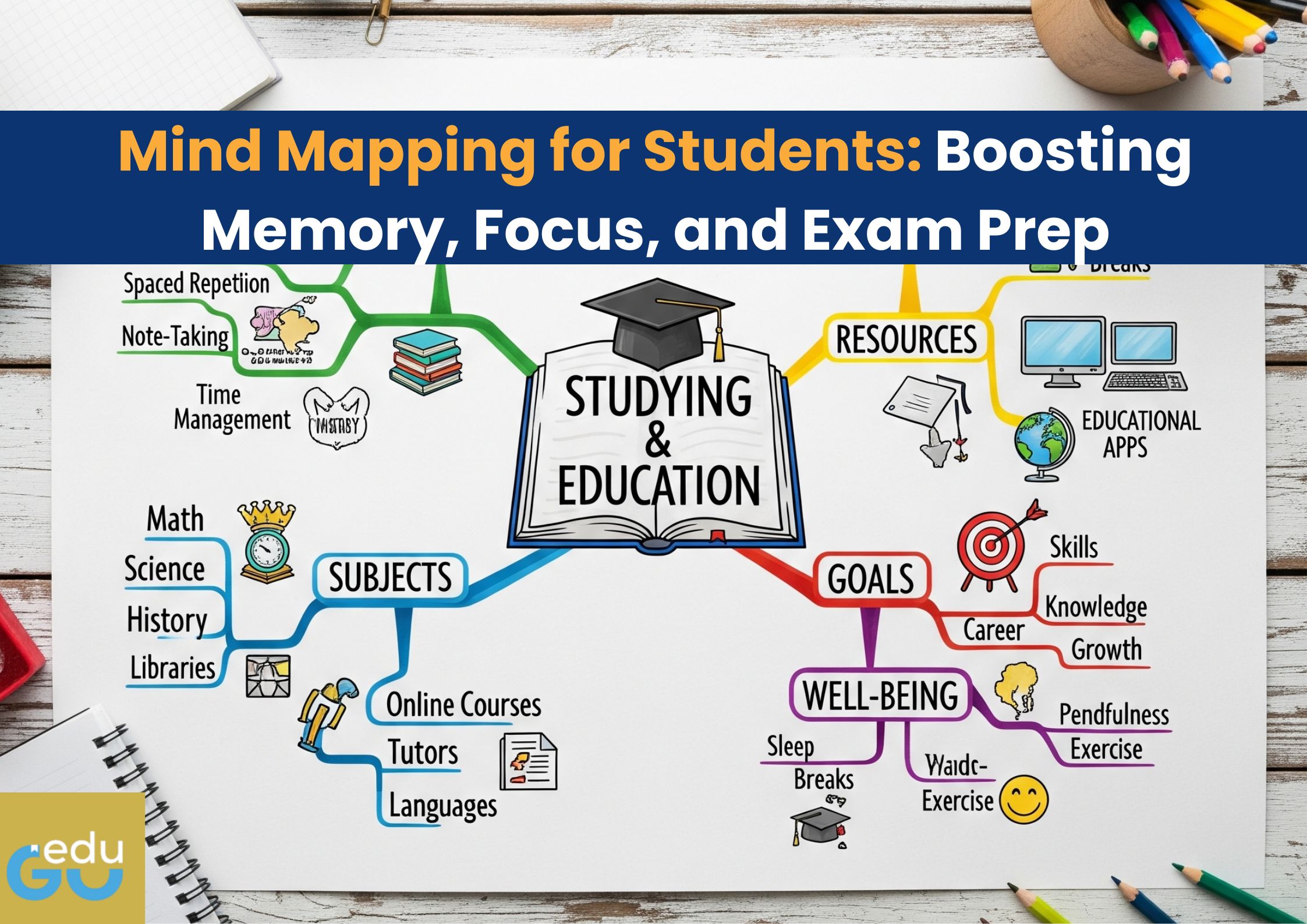
A mind map is a form of visual diagram that starts at one point (the center), the main idea, or subject of focus, and then expands horizontally or branching outwards into related topics, subtopics, and details. The concept of mind mapping was popularized by Tony Buzan, despite the fact that humans have been associating and connecting ideas since the dawn of mankind.
Mind maps are not linear like traditional notes, nor are they full of turgid text. Instead, they are composed of keywords, colors, and images to create a structured but adaptable overview of a subject. Because mind maps rely primarily on a visual learning style, they also lend themselves to being great for students who want to have a “big picture,” and able to refine and condense a subject without loosing the fine detail.
Why Do Mind Maps Work for Students

Improves Memory Retention
Mind maps use both sides (logical and creative) of the brain. You can combine words, colors and visuals to form stronger connections in your mind, making it easier to bring the information back during an examination.
Increases Attention
When you produce a mind map, you are forced to reduce the information into keywords and logical relationships. This requires you to pay attention and keeps you from spacing out.
Stimulates Creative Thought
Mind mapping also encourages you to think freely and make associations between ideas you might not see in a standard outline. This is especially true when planning a longer paper, brainstorming, or problem solving.
Makes Studying for Exams Easier
Mind maps help squeeze entire chapters and/or topics down to one page for revision, creating a more efficient study process. You can easily locate and revisit key points without having to reread large amounts of notes.
Step-by-Step Guide on How to Come Up With a Mind Map
Although creating a mind map is easy, following a systematic plan will make sure that you have maximized your work.
1. Choose Your Central Topic
In the middle of your page, write down the primary thing that you’re going to talk about (e. g., “Biology Exam” or “Shakespeare’s Plays”).
2. Add Main Branches
Draw lines coming out from the centre for your main topics or chapters.
3. Expand with Sub-Branches
Include additional facts, samples, or words which define in smaller branches.
4. Use Keywords, Not Sentences
Ensure that every branch has only one or two words so that you can easily remember them.
5. Incorporate Colors and Images
Assign distinct colors to each branch and put some relevant symbols or simple drawings around the map to highlight it better.
6. Review and Update
Increase or move branches as necessary when adding new information to maintain a useful map.
Pro Tip: Do not put too much text on your mind map as it may become difficult to read. The aim should be clear communication and not an overcrowded space.
Using Mind Mapping as a Study Tool

Mind mapping can be extremely helpful when preparing for an exam. Here are some ways you can use mind maps while studying before exams:
- Take your syllabus and turn it into a mind map. This means breaking individual subjects down into topics and sub-topics to tell a visual story about each subject.
- Use bright colors and pictures to highlight core concepts. This can really reinforce the image in your memory.
- Hide areas of your mind map with your hand or a piece of card for active recall of knowledge elements.
- You could even make condensed revision maps as your exam approaches, to help you revise everything in one go.
You can even make a PDF template of a blank mind map you can then use on hard copies or digital documents across subjects.
Digital vs Paper Mind Mapping
Digital mind mapping and paper mind mapping each provide unique benefits.
Paper mind mapping facilitates creativity and is open to freehand drawing, allowing the mind map to be a unique and more individual, memorable process. It’s also beneficial for studying offline with all the distractions that technology entails.
Digital mind mapping allow easy editing, scanning, sharing, and storage. There are many mind mapping apps that offer templates, collaboration options, and integrations with other study tools. XMind, MindMeister, Coggle and Canva’s mind map templates are a few popular options.
Successful Mind Mapping in Action
One high school student found a way to convert a 200-page history textbook into 15 maps. And she raised her test score by 20%. She could recall historical events and dates better because of the mind mapping.
A pre-med student used digital mind maps in his anatomy class. He could revise while he was on the go. And he could share the mind maps with his fellow students. Not only did this make their time together more productive, it was also an effective way to know and understand complex body systems.
In these examples, we see mind mapping work in the real world, not just the theoretical world. The results are measurable, and the support and success are valuable.
Strategies to Optimize Mind Mapping

- Utilize spaced repetition for mind maps, use your maps again with spaced intervals to enhance memory making.
- Use active recall, hide branches, and try and recall the hidden information.
- If you want to incorporate colored mind maps, be sure you keep them visually interesting with colors, icons, or branch styles.
- Consider combining mind mapping with other study strategies like flashcards, practice tests, or discussions with your peers for a well-rounded learning experience.
Conclusion: Study Smarter, Not Harder
Mind mapping is more than just a pretty diagram — it’s a proven study technique that can help students improve memory retention, focus, and efficiency with their exam preparation. By translating complex information into a clearer, visual form, you will not only learn your subjects better but recall them much quicker when you need them.
So grab a pen and paper or open your favorite mind mapping tool, and start mapping your way to academic success.
Frequently Asked Questions (FAQ)
1. What are mind maps, and how can this technique be of use for students?
Mind mapping is a visual-learning technique that organizes information visually from a central idea in interrelated branches, keywords, and pictures.
For students, mind mapping provides better retention of memory, increased attention span and focus, and promotes a more efficient study-by-studying and exam preparation method by providing at a glance the “big picture” and important details in one visual map.
2. Is mind mapping better than traditional note taking methods?
For many learners, yes. Mind maps use colors, visuals, and a non-linear format connected by radiating intersections and use of key words together that assist in recalling information easily when compared to traditional note taking.
Traditional note taking can often be very useful if you need to explain details, while mind mapping is more efficient and effective for summarizing, brainstorming, and reviewing.
3. Can mind mapping help me better understand and study at exam time?
Yes, it can help! Mind maps organize a large amount of study material into a single diagram, and that’s very convenient.
A mind map also makes it easier for students to easily review, and visualize important key concepts, as well as identify problems or gaps in their knowledge, and recall information that can assist them during exams.
4. What are the best tools for using digital mind mapping?
For students, digital mind mapping tools like: XMind, MindMeister, Coggle and, Canva are great examples.
The apps for these tools can help enhance your mind maps with their use of templates, collaborate with others as well as add your maps to the cloud storage where maps can be created, edited and shared instantly.