

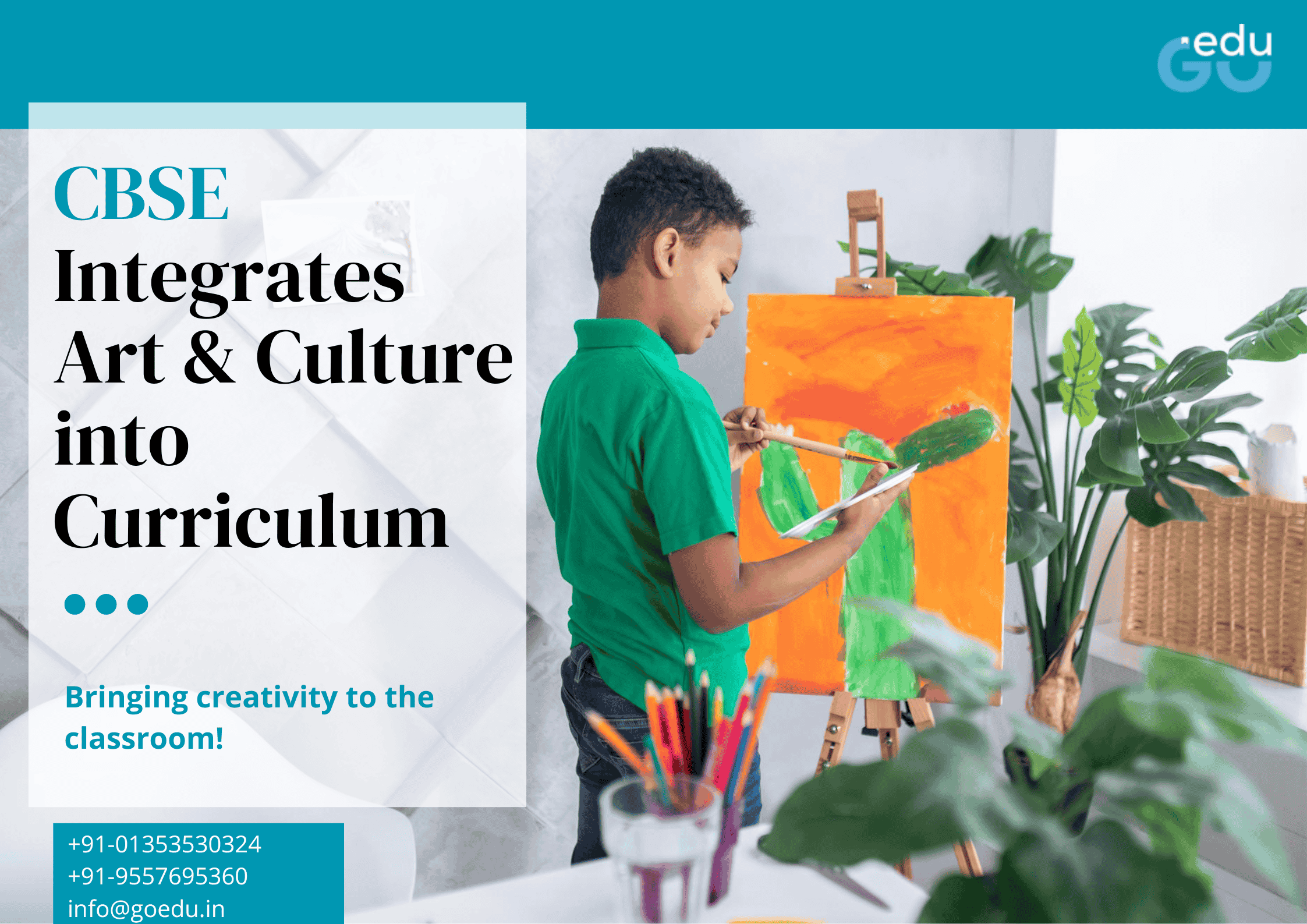
In a significant move that promises to transform traditional education, the Central Board of Secondary Education (CBSE) has announced a major curriculum change: integrating arts & culture into core academics for Classes I to X, starting from the 2025–26 academic session.
This effort is in line with the National Education Policy (NEP) 2020 and the Ek Bharat Shreshtha Bharat (EBSB) scheme, seeking to foster creativity, cultural literacy, and collaborative learning. The action is being widely appreciated, particularly by schools such as boarding schools in India, where values-based learning and overall education have a central priority.
Let’s delve into how this policy change is going to affect students, teachers, and the future of Indian education.
Understanding the New Arts & Culture Integration Policy

What Does the New Policy Include?
The new CBSE directive requires all subjects—Maths to Science to English—to have at least one art-integrated project every year. The projects will also demand students to relate the subject to a type of arts & culture, e.g.:
- Visual arts (painting, sculpture, textile design)
- Performing arts (music, dance, theatre)
- Literary arts (storytelling, poetry, folk literature)
- Cultural studies (crafts, festivals, architecture)
For instance, a science project can be creating an environmentally friendly model based on tribal art, whereas a social science project can be the discovery of another Indian state’s cultural symbols.
Why Emphasize Arts & Culture in Schools?
1. Alignment with NEP 2020 Objectives
The NEP 2020 promotes multidisciplinary, experiential education. The inclusion of arts & culture aligns with these objectives by:
- Enabling students to think creatively and critically
- Enabling cross-disciplinary connections
- Fostering cultural literacy and awareness of diversity
2. Cultivating Holistic Learners
Typical rote learning tends not to appeal to students on an emotional or creative level. By incorporating arts & culture into general education:
- Students express themselves more and think more creatively
- Learning is entertaining, relevant, and memorable.
- Emotional and social intelligence is developed.
This method works particularly well in settings such as boarding schools in India, where personality development is the main agenda.
How Will It Work in Classrooms?

1. Interdisciplinary Project Work
Each subject teacher will include one art-based project in the annual curriculum. These shall not be isolated “craft projects” but tasks closely related to academic learning. Examples are:
- Utilizing origami to describe geometry in Maths
- Developing traditional puppets to describe grammar lessons in English
- Developing environmental models inspired by local architecture in Science
2. Collaboration and Group Work
Students will work in small groups or pairs to develop teamwork and communication skills as they study arts & culture. This cooperative learning strategy reflects the principles of unity and diversity encouraged in Ek Bharat Shreshtha Bharat.
3. Eco-Friendly & Cultural Guidelines
CBSE requires all art projects to be:
- Environmentally friendly (recycled or natural material-based)
- Region-specific, tapping into the Indian states’ cultural heritage.
- Age-qualified and inclusive, accessible to students of every learning ability
Educational Value of Arts & Culture in the Curriculum
Enhanced Academic Success
As widely believed, incorporating arts & culture into the classroom is not a distraction from academic success—it enriches it. Students involved in artistic activity are better performers in core academic areas because:
- Arts enhance visual-spatial ability, helping with math and science
- Performing arts enhance memory, concentration, and discipline.
- Creative thinking improves problem-solving and reasoning.
Improved Emotional and Social Development
Emotional intelligence is as important as intellectual ability in today’s world.
arts & culture
- Assist students in exploring identity and empathy
- Lessen academic stress through creative expression.
- Foster a sense of belonging and community.
All the more important for students attending boarding schools, where individual development is as important as academic achievement.
Cultural Awareness and National Unity

One of the strongest effects of this policy is that it aligns with the Ek Bharat Shreshtha Bharat movement. By assigning schools to states other than their own, students:
- Learn about other regions’ languages, traditions, and art forms
- Develop an appreciation for India’s cultural diversity.
- Visualize themselves as members of a united, multicultural nation.
For instance, a Rajasthan school could be twinned with Kerala, and students would learn about Kathakali dance, Malayalam script, or Onam festivals as part of their homework.
Role of Teachers and Schools
Teacher Training and Support
CBSE will assist schools by:
- Organizing teacher training sessions on embedding arts
- Providing sample project templates and guidelines
- Opening digital portals for sharing resources and reporting
Teachers will not only learn to lead art projects but also to evaluate them during internal evaluation.
School Infrastructure and Leadership
Schools are encouraged to construct or enhance:
- Art rooms or studios
- Cultural libraries containing literature on Indian traditions
- Partnerships with local artists or cultural bodies
Leadership from school heads will be pivotal in making this policy meaningful and sustainable.
How Will Students Be Assessed?
Art-based tasks will be included in the internal assessment framework. Teachers will assess students according to:
- Originality and creativity
- Relevance to the subject
- Teamwork and participation
- Understanding of cultural context
This change moves away from marks-based assessment to a more holistic assessment of student potential.
Arts & Culture: A Step Toward Future-Ready Learning
With escalating worldwide demand for imaginative, flexible, and compassionate workers, incorporating arts & culture into education is not simply a cultural or moral move—it’s an investment in education.
Students who learn through art as children:
- Are more effective communicators
- Do things differently
- Are more culturally aware and socially responsible
Final Thoughts
The CBSE’s decision to integrate arts & culture into the school curriculum is a bold and necessary move in the right direction. It redefines success in education—not just as academic excellence, but as cultural awareness, emotional growth, and creative potential.
Parents and students alike should welcome this change, not only for its academic value but also for how it prepares young minds for a balanced, confident, and compassionate future.
Frequently Asked Questions
1. Is this policy mandatory for all CBSE schools?
Yes, from the academic year 2025–26, all CBSE-affiliated schools must integrate at least one art-based project per subject from Classes I to X.
2. What kinds of art forms can be included?
Visual arts, performing arts, storytelling, folk traditions, music, crafts, and other Indian cultural practices are encouraged.
3. Will these projects affect grades?
Yes. These projects will be part of the internal assessment and evaluated based on creativity, relevance, and execution.
4. How are schools expected to manage resources for such projects?
CBSE is providing training and digital support, and schools are encouraged to collaborate with local artists, use eco-friendly materials, and engage communities.
5. What is the benefit of linking subjects like Math or Science with arts & culture?
It promotes creative thinking, better retention of knowledge, and helps students see real-world connections between subjects and society.