



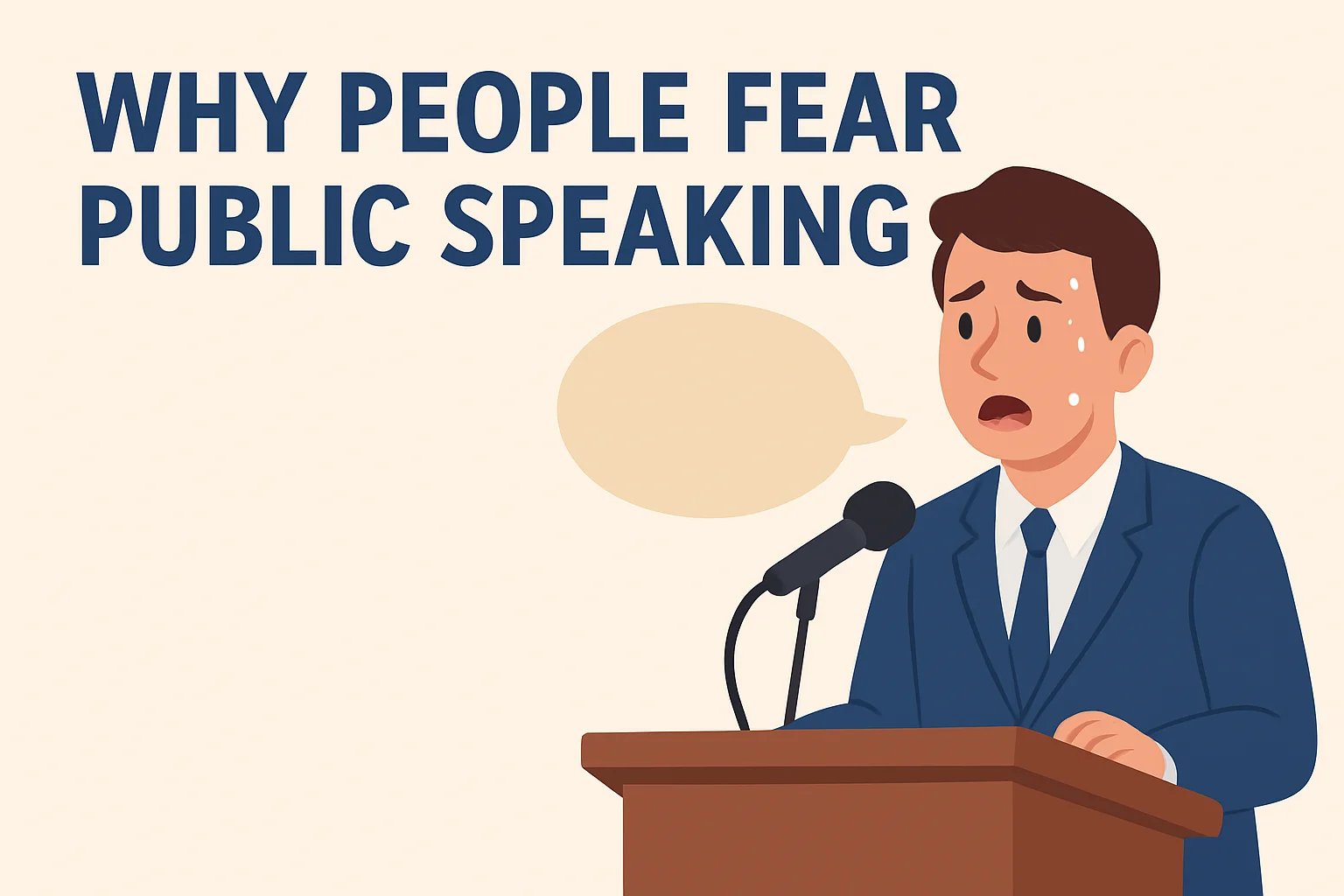
Have you ever felt your heart pounding at the thought of speaking to a group? That sensation in your stomach isn’t just anxiety– it’s your brain activating an age-old survival system which helped keep our ancestors alive.
The Numbers Tell a Powerful Story
You may be surprised by how many people dislike public speaking– they are not alone.
A recent study shows that 77% of adults get nervous when talking in front of a group (roughly three out of every four people). Indeed, 15 million Americans experience such extreme terror they have a daily fight with glossophobia– the technical term for this fear!
Interestingly females are more likely than males to feel anxious about giving oral presentations: 44% compared with 37%, respectively. But what is it about speaking that makes us so scared?
After all, our apprehension exceeds common phobias like spiders, heights, or even death! This widespread dread must tap into something fundamental in human nature if it evokes such a strong response across cultures— although psychologists have their theories as to why.
Why Our Brains React This Way
Ancient Survival Instincts
For ages, humans have felt fear speaking in public– and there’s an evolutionary reason why.
Our early ancestors lived in small groups; being accepted was essential for survival while rejection could have fatal consequences. If you were cast out, you became prey for predators or had to face tough weather alone.
Every so often, just before we have to speak in front of others, an odd old feeling springs up: that primitive alarm system going off inside us.
Our brains just can’t figure out the difference between presenting at a team meeting and being banished from the group– although both scenarios are usually very different!!
That brain— you see it as your boss in a meeting rather than a pack with wolves– continues to respond as if its life hung on whether those people liked us or not!
The Brain Freeze Phenomenon
Have you ever forgotten everything during a presentation?
There’s an answer to this very common problem– and it comes from science.
Dr Michael DeGeorgia of Case Western University explains that when we feel anxious, stress chemicals flood an area of the brain called the pre-frontal cortex.
Because this part of the brain is needed for recalling memories and thinking clearly, making it impossible for us to think straight or remember what we wanted to say.
This leads to what scientists call an “unpleasant spiral”: if we worry about forgetting our words, then we become more likely to have that blank moment.
Our brains therefore switch off exactly the functions that we most need when talking in front of an audience.
Common Triggers and Root Causes
Fear of Judgment
So, where does glossophobia come from?
It taps into a really old fear– humans don’t want other people to judge them badly.
This fear can show up in different ways:
- Worrying you’ll look unprepared or not clever enough
- Anxiety about being laughed at or making a fool of yourself
- Fear that critical bits of your speech will escape your mind
- Concern over whether trembling hands or sweaty palms give you away
Past Negative Experiences
Research indicates that individuals are not inherently born with a fear of public speaking; rather, they acquire this phobia after experiencing negative events while giving presentations.
For example, if you have been mocked or had a particularly poor day during a school speech, these one-off occurrences may leave you feeling anxious about using your voice in general– because such things can cause lasting psychological scars.
Perfectionism and High Expectations
Sometimes, individuals who set sky-high goals for themselves encounter more nerves about speaking publicly.
They feel as though everyone is watching them perform better than they have ever performed before! This pressure might lead to avoiding situations altogether– or it can increase anxiety levels.
The Real-World Impact
Educational Consequences
Sometimes, crippling fears of speaking can harm students’ academic performance.
A startling number of students— around 80% in the UK— say giving presentations makes them terribly anxious.
The consequences of this dread are far-reaching:
- Shunning courses that involve presenting
- Enduring lower marks for participation
- Missing out on valuable learning during discussions
- Forgoing the opportunity to build relationships with peers and faculty
Professional Limitations
The fear of speaking in public can be a major obstacle at work, and it’s not uncommon for people to avoid situations where they have to talk in front of others.
This can make it hard to move up in a career because so many jobs require the ability to present information clearly– and if you do have to speak up, they also want you to sound confident.
You might find that you are:
- Missed out on for leadership roles
- Passing up vital opportunities to network
- Having difficulty pushing your ideas effectively
- Finding yourself limited when it comes to coaching colleagues.
The Silent Struggle
A potentially worrisome aspect of this is that merely around one in ten individuals afflicted with glossophobia pursue professional assistance.
Instead, most go to great lengths to conceal their discomfort, devising complex schemes to dodge scenarios that involve speaking out loud– rather than coming to terms with the fear itself.
Education and Confidence Levels
An interesting observation can be made regarding education: it holds great importance for confidence when speaking. Research reveals that more than half of individuals (52%) whose highest level of education was high school– or who left school earlier– say they fear giving presentations to groups!
Meanwhile, this fear is reported by just one in four (24%) graduates. It is quite likely that experiencing speaking opportunities and receiving academic training assist in building confidence as they grow older.
Comfort levels also seem to improve with age. Approximately 69% of those aged 45 and up feel confident when speaking in public– whereas only a quarter (25%) of young people aged 16 to 24 say the same thing.
Naturally, life experience helps reduce anxiety– as does coming face-to-face with it time after time!
Building Resilience and Confidence
Preparation as Your Foundation
Effective preparation is known to greatly reduce speakers’ anxiety– sometimes even eliminating it altogether.
Research suggests that around 9 times out of 10 (90%) feeling nervous before giving a presentation comes down to not being prepared enough.
It makes sense really: if you know your stuff inside out and have practiced going through it a few times, then confidence levels tend to rise quite dramatically!
The Power of Practice
Public speaking, like any other skill, gets better the more you practice it.
So why not start with a small group of friends or family? As you gain confidence speaking to them, move on to bigger audiences– one step at a time.
Each new success will change how your mind feels about talking in front of groups.
Understanding Your Triggers
It is important to pay attention to the specific causes of your anxiety.
Is it the number of people present? The fear that you will be unable to answer questions? Or concerns about potential technical problems?
Once you identify your particular fears, you can figure out strategies for dealing with them directly.
Moving Forward with Hope
It’s totally normal to be scared of speaking in public– even people who have done it a lot feel the same way. Abraham Lincoln was so nervous before giving the Gettysburg Address that he stayed up all night writing it.
Mahatma Gandhi was terrified of speaking in front of crowds when he first started out– and many actors say they still get butterflies before going on stage!
The thing is: that panic you feel is really old. It’s hardwired into us because way back then being watched meant danger.
But here’s the good news– with some know-how, getting ready, and taking small steps, you can change how you feel about public speaking. Indeed, every pro was once a rookie trembling with nerves.
What sets them apart is deciding to step up despite those jitters rather than letting fear hold them back. Your voice and ideas are important! Don’t let an ancient survival trick stop you sharing them with others.
Frequently Asked Questions
1) What is glossophobia?
If you have glossophobia you have a fear of speaking in public. The term glossophobia comes from two Greek words, “glossa” meaning tongue and “phobos” meaning fear. It is an appropriate name for this common fear because speaking in front of others often makes individuals feel so nervous that they cannot speak at all.
2) Why does speaking in public cause more phobias than other fears?
The idea of talking in front of others has always been a very important skill for survival and reproduction in human society. Our brains are hardwired to treat social rejection like a life-threatening situation from which we need to escape immediately.
This is why the thought of giving a speech or presentation can cause an intense fight-or-flight reaction even though we know logically there is no real danger involved.
3) How can I reduce my fear before giving a talk?
One common recommendation is to think about what you want to say in detail before the talk, practice speaking in front of small groups or a mirror and visualize yourself giving a successful talk. It may also help to identify specific fears (such as fear of forgetting one’s lines) so they can be dealt with individually.
4) When should I get professional help with my speaking anxiety?
Your fear of speaking might interfere with important opportunities for school or work if you avoid giving talks or presentations at all costs. If symptoms like panic attacks disrupt daily activities too much, seeing a counselor could help.